Phone: (239) 963-5131
Email: ktiuso@naplesliteracy.com
Dyslexia & Reading
A Quick Guide to Understanding Dyslexia
& Effective Instruction
Current research shows that dyslexia affects approximately 1 in 5 people, yet it remains one of the most misunderstood learning differences in education today.
Dyslexia is not a reflection of intelligence, but rather a neurobiological difference in how the brain processes language.
At Naples Literacy, we hope to help parents, educators, and individuals understand what dyslexia is, how it is identified, and what effective support looks like to create a more inclusive environment for our students that empowers them.
The Reading Process
Before defining dyslexia, it helps to first understand how reading actually works, because reading does not come naturally to the brain the way spoken language does. Unlike talking, reading is a skill the brain must be carefully & explicitly taught.
Skilled reading involves more than just one skill. Skilled reading involves many different, complex cognitive skills working together, all building toward the same goal: understanding what we read.
At Naples Literacy, we believe every reader deserves instruction built on the best available research. That's why our approach is rooted in two foundational frameworks, along with various reading theories: The Reading Rope and The Active View of Reading, ensuring instruction reflects what science tells us skilled reading truly requires.
The Reading Rope
Scarborough's Reading Rope, developed by researcher Hollis Scarborough (2001), is one widely accepted reading theory model that illustrates just how many skills are woven together, like DNA, in the act of skilled reading.
The rope is made up of two main strands:
-
Language comprehension: which includes background knowledge, vocabulary, language structures, verbal reasoning, and literacy knowledge.
-
Word recognition: which includes phonological awareness, decoding, and sight recognition of familiar words.
Over time, as a reader develops, these strands become increasingly intertwined, until reading feels automatic and effortless. The model helps us understand that a weakness in any one of these threads can affect the whole rope. For students with dyslexia, it is typically the word recognition strand where the greatest challenges lie.

The Active View of Reading
The Active View of Reading, developed by Drs. Nell Duke and Kelly Cartwright, is a research-based way of understanding how children learn to read. This view builds on The Reading Rope's essential components & offers an inclusive and holistic view of reading development.
This model emphasizes that reading is not only about skills and knowledge, but also about how children engage with reading.
Motivation, interest, engagement, and the ability to think strategically all play a key role in becoming a strong reader. At NLC, we embrace both views of reading and acknowledge reading is an active process where children can engage in metacognition, curiosity, and effort to make meaning from what they read.

What is Dyslexia?
Dyslexia is simply a different way of thinking due to anatomical differences in the brain. People with dyslexia have a different way of processing language and understanding the world...one that often comes with incredible strengths.
Many individuals with dyslexia are highly creative and talented problem-solvers. While dyslexia does present challenges in reading and language processing, it is also frequently associated with unique strengths. Here at NLC, we seek to highlight these strengths for our students!
That’s why we strive to use language that recognizes and celebrates strengths while also acknowledging the real difficulties students with dyslexia may face.
Our goal is to empower students through evidence-based instruction that highlights their talents, supports their growth, and helps them recognize their full potential & not be limited by a label.
Check out the videos below for more information!

About Dyslexia
At the heart of dyslexia is a phonological processing deficit (see more below to learn about phonological processing), or a difference in how the brain processes the sound system of language, due to anatomical differences in the brain. In other words, the brain has difficulty connecting sounds to letters, which makes decoding, or reading, words a significant challenge.
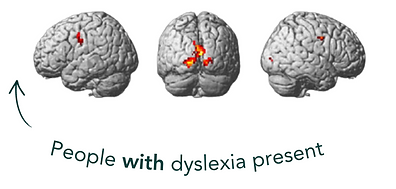
Brain imaging research using fMRI (functional magnetic resonance imaging) has given us a remarkable window into why this happens. In individuals with dyslexia, the network of brain regions responsible for connecting sounds, letters, and meaning tends to be under-activated, particularly in the areas that link letters to their corresponding sounds. Below shows an example of brain activity with and without dyslexia present.
While the exact causes of dyslexia are still being studied, what we can see clearly is that the people with dyslexia process language differently.
The Good News: People with dyslexia have amazing talents! Often, people with dyslexia are wonderful storytellers, creators, entertainers, and inventors. Reading and writing challenges due to dyslexia CAN be conquered. Brains are changeable! Scientists call this neuroplasticity, or the brain's remarkable ability to grow and rewire itself in response to learning. Here at NLC, we believe in the transformative power of effective, research-backed instruction and have seen first-hand the confidence and hope it can bring our students.
Research consistently shows that with effective, evidence-based reading instruction, brain activity patterns in individuals with dyslexia can shift, and reading skills can improve! We believe and have seen firsthand the impact of effective instruction and the hope it can bring students.
Information presented by Brennan Chandler, Ph.D. "Demystifying Dyslexia: A Parent's Guide to Understanding and Support". Research: Shaywitz et al., 2002; Gabrieli, 2009; Kearns et al., 2019.
Images: Habib, Michel, 2021.

Phonological Processing
Because dyslexia is a phonological processing deficit, it is important to define this terminology for a clear picture. Phonological processing refers to how we hear, identify, and work with the sounds of spoken language. For children with dyslexia, this is often where reading breaks down. Research identifies three key areas: phonemic awareness, phonological memory, and rapid naming.
Phonological Memory: the ability to hold sound-based information in working memory long enough to use it. This affects a child's ability to sound out and blend new words.
It's important to remember that dyslexia doesn't look the same in every child. Some may struggle primarily with sound awareness, while others find rapid naming or broader language skills more challenging. Understanding a child's individual profile is key to providing the right support.
Research: Shaywitz et al., 2002; Gabrieli, 2009; Kearns et al., 2019.
Signs of Dyslexia at Every Age
Source: "Dyslexia Signs at Different Ages." Understood.org.
Identifying Dyslexia
Recognizing the signs of dyslexia early is key to providing effective intervention.
Proper identification requires individualized testing by a qualified professional, such as a licensed psychologist, educational diagnostician, or certified reading specialist.
A comprehensive evaluation typically includes assessments of phonological processing, decoding & word recognition, orthographic knowledge, reading fluency/accuracy, spelling and writing, language comprehension, and a review of academic history.
At Naples Literacy, we use research-based assessments, including the Test of Dyslexia (Mather, N., McCallum, R. S., Bell, S. M., & Wendling, B. J., 2024) from Western Psychological Services to identify dyslexia and pinpoint specific areas of need.
Families meet with Karli Tiuso to review their child’s detailed report together. During this time, we discuss results, strengths and areas for growth, and provide practical recommendations to support reading development.
For local providers offering full educational evaluations, please contact Karli Tiuso. We love connecting families to trusted providers to ensure families feel confident in supporting their student.
Dyslexia Intervention
Research continues to show us not only what skills students need to learn, but also the most effective strategies for teaching them. For effective dyslexia intervention, students should receive instruction from a reading specialist trained in structured literacy and multi-sensory methods aligned with the science of reading.
Here at NLC, as a Certified Dyslexia Interventionist, our dyslexia intervention includes personalized, evidence-based reading intervention that is designed to specifically help students with dyslexia strengthen their reading, writing, and spelling skills.
Aligned with practices supported by the science of reading (click here to learn more about the science of reading) and Structured Literacy principles, here at NLC, dyslexia intervention is systematic, explicit, prescriptive, and evidence-based.
Our dyslexia intervention is grounded in decades of reading research proven effective for students with dyslexia. Here at NLC, we also believe great literacy instruction is both a science and an art.
It is shaped not only by what we teach, but by how we teach. This happens through meaningful relationships, thoughtful observation, and intentional responsiveness to each student we serve.
All students at NLC receive individualized, detailed goals to support student growth and ensure clear, ongoing communication with families.
Source: Carolyn Cowen, International Dyslexia Association (dyslexiaida.org)

Additional Parent Resources
For more information, we encourage families to explore the following trusted materials and resources.
Made by Dyslexia: Dyslexic Thinking Parent Guide
Made By Dyslexia is a global nonprofit organization that works to redefine dyslexia as a strengths-based difference in thinking and learning. Their resources include videos, research, and practical tools designed to help parents, educators, and employers better understand dyslexia and the strengths that often come with it, such as creativity, problem-solving, and big-picture thinking. Their mission is to ensure that every person with dyslexia is understood, supported, and empowered to succeed.
Understood.Org: All About Dyslexia
Understood.org is a trusted resource for families and educators seeking clear, practical information about dyslexia. Their library includes videos, tips, and research-based strategies to help parents better understand how dyslexia impacts reading and learning. They also provide guidance on effective accommodations, classroom supports, and ways to build a child’s confidence as a reader.
Dyslexia Resource Hub by UFLI Foundations
University of Florida Literacy Institute (UFLI) offers a trusted, research-based Dyslexia Resource Hub designed to help parents, educators, and advocates better understand dyslexia and how to support students who learn differently. This collection includes clear explanations of dyslexia, webinars, and practical tools grounded in the science of reading. It also provides guidance on effective, evidence-based instruction and intervention, as well as information about student rights and appropriate supports. The resources help families move past common myths and misunderstandings, offering a clearer, more informed picture of what dyslexia is and how children with dyslexia can succeed when given the right instruction and support.
Information Sourced:
The information above was compiled from trusted, research-based sources and contributions from leading experts in the field of literacy and dyslexia and includes materials and presentations from Dr. Brennan Chandler, University of Florida College of Education School of Teaching & Learning and the University of Florida Literacy Institute (UFLI) Foundations, the International Dyslexia Association, and Understood.org. Additional insight was informed by the research and work of literacy experts Jan Hasbrouck and Louisa Moats. Together, these sources represent current, evidence-based understanding and best practices in the field of dyslexia and structured literacy instruction.
Hasbrouck, J. E. (2020). Conquering dyslexia: A guide to early detection and intervention for teachers and families. Benchmark Education.
Moats, L. C. (2010). Speech to print: Language essentials for teachers (2nd ed.). Paul H. Brookes Publishing Co.